

When people think about creating a clothing collection, they often picture sketches, trend boards, color palettes, and fabric swatches. While these creative decisions help define a garment's visual identity, they aren't where a successful product begins. It begins with research and development (R&D).
Before selecting silhouettes or trims, every apparel brand must answer the core question:
What Does This Garment Need To Do?
Once the garment's intended function is established, one of the first product development decisions becomes selecting the appropriate woven fabric construction. This choice influences nearly every aspect of the finished product, from how the garment fits and drapes to how long it lasts in a customer's wardrobe.
Should it hold a crisp, tailored silhouette? Flow effortlessly with movement? Resist wrinkles throughout the workday? Manage moisture during activity? Perform in demanding environments?
Many unsuccessful products aren't the result of poor design. Instead, they're the result of selecting a fabric whose construction doesn't support the garment's intended purpose.
Looks Can Be Deceiving
Most consumers have experienced this difference without realizing why. Imagine purchasing two white button-down shirts online. Both appear nearly identical. Both are labeled 100% cotton. Both target the same customer.
Once they arrive, however, the similarities quickly disappear. One wrinkles after only a few hours, feels stiff against the body, and is rumpled by the end of the day. The other resists wrinkles, feels comfortable, and maintains its appearance throughout the day.
Although the fiber content is identical, the garments perform completely differently. The difference is often found in the woven fabric construction. How yarns are arranged within a textile determines its mechanical behavior, including drape, stability, wrinkle resistance, durability, and flexibility.
Understanding these principles allows designers, product developers, and sourcing professionals to make informed decisions long before production begins.
Pro Tip: When evaluating supplier swatches, don't stop at fiber content. Examine the weave structure, weight, density, and finishing processes to understand how the fabric will actually perform.
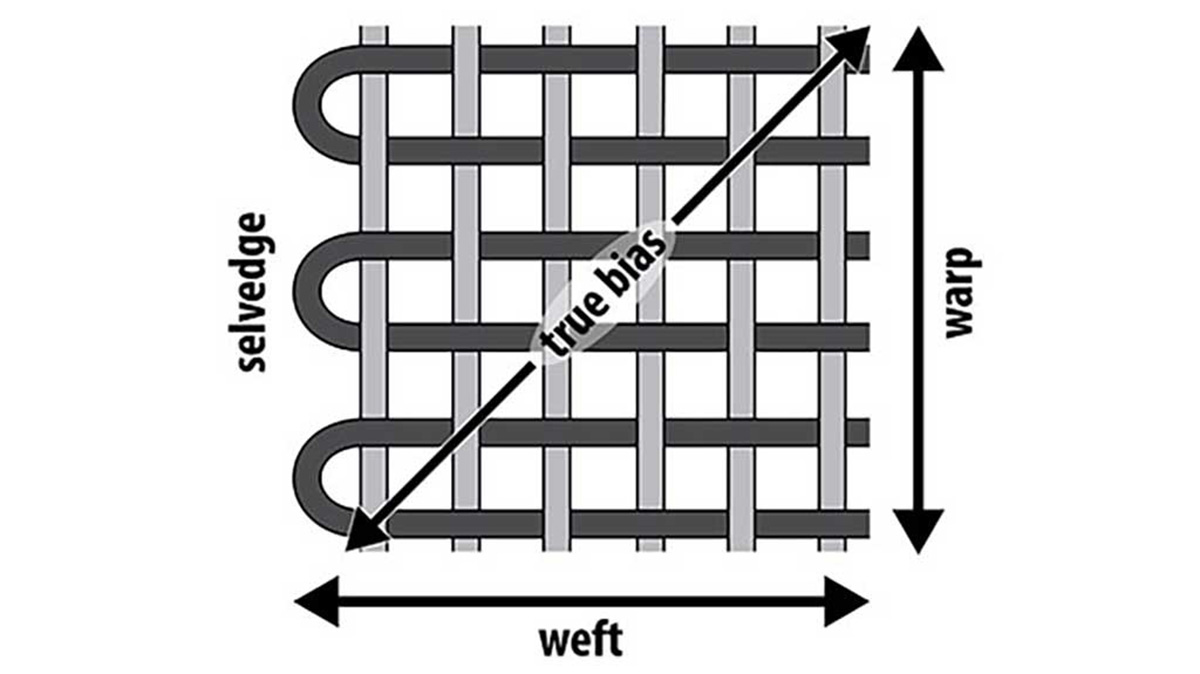
Grain direction affects how fabric hangs, stretches, and behaves. Image via canada.ca
Warp and Weft Explained
Every woven textile begins with two sets of yarns that intersect at right angles and create the foundation of the material. Understanding warp and weft is one of the most important fundamentals of apparel fabric construction, because every woven fabric, regardless of fiber or appearance, is built using this same principle.
Warp yarns run lengthwise through the fabric and remain under tension throughout the weaving process. They provide much of the fabric's strength, stability, and dimensional consistency.
Weft yarns, sometimes called filling yarns, are woven horizontally over and under the warp yarns to create the fabric's width. Depending on the weave structure, they contribute to flexibility, drape, texture, and visual appearance.
Together, these two yarn systems create the stable structure that defines woven fabrics.
Unlike knit fabrics, which rely on expandable loops, woven fabrics lock yarns together through repeated interlacing. This creates a material with little natural stretch, excellent dimensional stability, and the ability to maintain its shape over time. Because of these characteristics, woven textiles are commonly selected for garments that require precision and structure, including tailored jackets, dress shirts, trousers, jeans, uniforms, and many outerwear styles.
Learning how warp and weft yarns interact also provides the foundation for recognizing different weave structures, evaluating supplier swatches, and communicating effectively during sourcing.
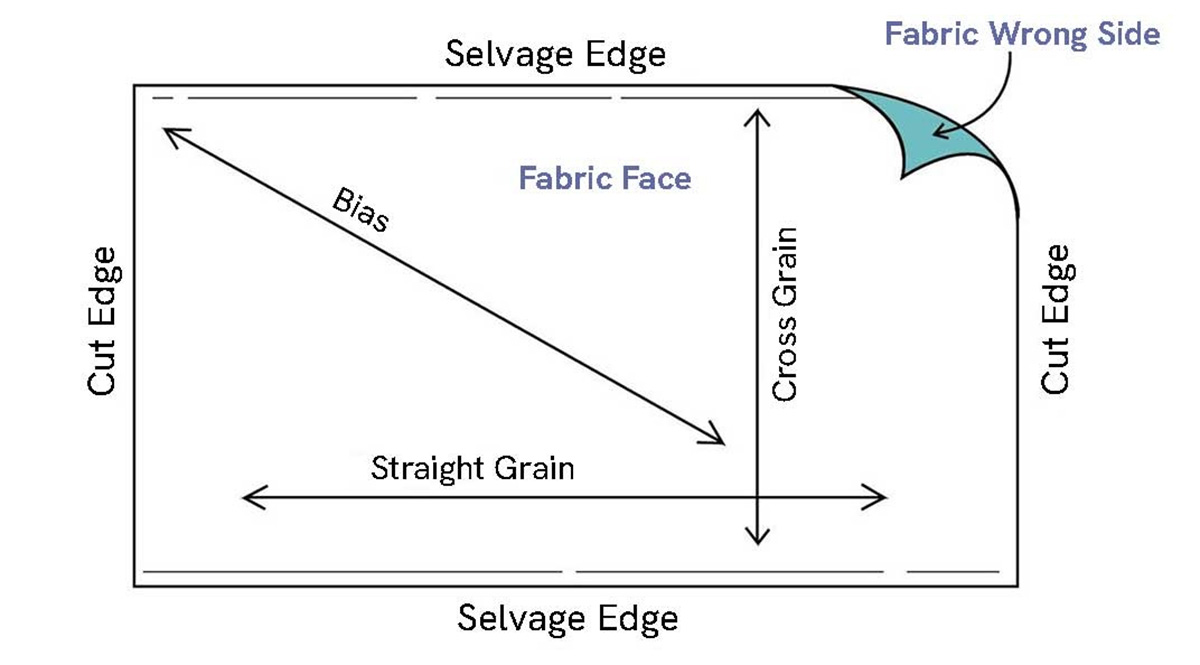
Understanding the grain in your fabric will allow you to properly lay out your patterns. Image via doinaalexei.com
Grain Direction: Straight, Cross, and Bias
Woven textiles have clearly defined grain directions created by the warp and weft yarns. How the pattern piece is positioned on the fabric affects how the finished garment hangs, moves, and holds its shape. Cutting on different grains produces different results.
Straight Grain
Runs parallel to the warp yarns and the selvage. Because the warp remains under constant tension during weaving, this direction provides the greatest stability and the least amount of stretch. Most garment pattern pieces are cut on the straight grain to preserve structure and ensure consistent sizing.
Cross Grain
Follows the weft yarns, running perpendicular to the warp. Cross grain offers slightly more give than the straight grain, while remaining relatively stable. It’s sometimes used in waistbands, yokes, or cuffs where subtle ease is desired.
Bias Grain
Runs at an angle to both the warp and weft. True bias is 45 degrees where the fabric reaches maximum stretch and fluidity, but any angle off the straight or cross grain is considered bias.
Cutting on the bias allows fabric to stretch and conform to the body’s curves, producing a fluid drape that moves with the wearer. This technique is popular for eveningwear, slip dresses, skirts, and scarves. Bias-cutting requires more careful handling. The fabric is prone to stretching and distortion during cutting and sewing, and patterns typically require more yardage due to the angled placement.
Selvage and Fabric Width
The finished edges running along both sides of a woven fabric are known as the selvages. Unlike cut edges, the selvage prevents the warp yarns from unraveling during weaving and helps maintain consistent tension throughout production.
Selvages establish the straight grain of the fabric and serve as a reference point during pattern placement.
Fabric width varies depending on the textile and the machinery. Many apparel fabrics are produced in widths ranging from approximately 45 to 60 inches (114–152 cm), although specialty fabrics may be significantly narrower or wider. Wider fabrics often allow more efficient pattern placement, reducing material waste and production costs.
Choosing the Right Construction for the Garment
There is no single "best" woven fabric. The right choice is the one that supports the garment's intended function. A lightweight blouse may need a construction that moves with the body, while a structured blazer requires stability and shape retention. Durable workwear often relies on abrasion-resistant twill constructions, whereas a tailored trouser needs a fabric that holds a crease and resists wrinkling.
As you evaluate supplier swatches, remember that fiber content tells only part of the story. Construction, weight, density, stretch, and finishing processes all work together to determine how a fabric will perform throughout the life of the garment.
By building a strong foundation in apparel fabric construction, designers, sourcing professionals, and fashion entrepreneurs can develop products that not only look exceptional but also perform as intended.