

Introduction
If you have ever looked at a piece of clothing and wondered why some fabrics stretch while others hold their shape firmly, you have encountered the fundamental difference between knitted and woven fabrics. These two categories represent the most common methods of fabric construction, and understanding how to tell them apart — as well as what goes into them — can help you make better choices when buying clothes, sportswear, or outdoor gear.
This article explains, in plain language, how to distinguish knitted from woven fabrics, and provides practical reference data on the maximum blend ratios for two popular fabric combinations: nylon + spandex and polyester + spandex.
Part 1: What Are Knitted and Woven Fabrics?
Woven Fabric
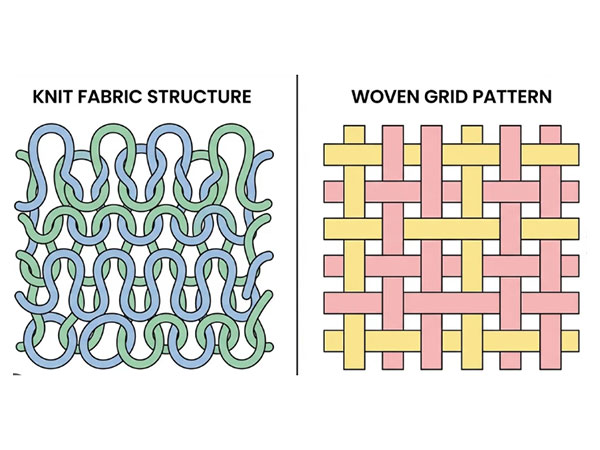
A woven fabric is made by interlacing two sets of yarns at right angles to each other. The vertical yarns are called warp yarns, and the horizontal yarns are called weft yarns. Think of it like a basket or a checkerboard — the yarns cross over and under one another in a regular pattern.
Woven fabrics have three basic weaves:
Plain weave — the simplest, with yarns alternating over and under each other
Twill weave — creates a diagonal rib pattern on the surface
Satin weave — produces a smooth, glossy surface with long floats
Knitted Fabric
A knitted fabric is made from one continuous yarn that is looped repeatedly, with each loop interlocking with the next. Think of it like hand-knitting a sweater — the yarn forms a series of interconnected loops.
Knitted fabrics are divided into two main types:
Weft knitting — loops run horizontally, like hand-knitting
Warp knitting — loops run vertically, creating a more stable structure
Part 2: How to Tell Them Apart — Three Simple Tests
You don't need a laboratory to distinguish knitted from woven fabrics. Here are three easy methods you can use anywhere.
Test 1: The Stretch Test
How to do it: Gently stretch the fabric in both directions — along its length and across its width.
What to look for:
Knitted fabric will stretch easily in both directions (lengthwise and widthwise). Some knitted fabrics can stretch over 200% in width.
Woven fabric will resist stretching or stretch very little, usually only along one direction. Woven fabrics typically have less than 30% elasticity.
Test 2: The Pull-Apart Test (Edge Test)
How to do it: Find an edge or selvage of the fabric and try to pull a thread out.
What to look for:
Woven fabric — threads at the edges come loose very easily. You can pull threads from both the width and length directions.
Knitted fabric — pulling a thread is much harder. If you manage to pull one out, you will see it unravels as a series of loops rather than straight threads.
Test 3: The Look Test
How to do it: Examine the fabric surface closely.
What to look for:
Woven fabric — you can see a clear criss-cross or checkerboard pattern where yarns intersect.
Knitted fabric — you will see tiny V-shaped loops or braid-like rows, similar to the surface of a sweater.
Quick Reference: Key Differences at a Glance
| Feature | Knitted Fabric | Woven Fabric |
| Structure | Loops interlocked | Yarns interlaced at right angles |
| Stretch | High, multi-directional | Low, minimal |
| Feel | Soft, comfortable | Firm, crisp |
| Durability | Moderate, can pill | High, very durable |
| Wrinkle resistance | Good — resists creasing | Poor — wrinkles easily |
| Typical uses | T-shirts, sportswear, underwear, sweaters | Shirts, suits, jeans, jackets, outdoor gear |
Part 3: Maximum Blend Ratios — Nylon + Spandex
Nylon (also called polyamide) is valued for its strength, durability, and abrasion resistance. Spandex (also called elastane or Lycra) provides stretch and recovery. When blended together, they create fabrics that are both tough and flexible — ideal for activewear, swimwear, and performance clothing.
Knitted Nylon + Spandex
In knitted constructions, spandex content can be relatively high because the loop structure naturally accommodates elasticity.
Common and maximum ratios observed in the market:
| Spandex Content | Nylon Content | Application Examples |
| 5–10% | 95–90% | Standard everyday knitwear |
| 15–20% | 85–80% | Activewear, sportswear |
| 20–25% | 80–75% | Compression wear, swimwear |
| 25–30% | 75–70% | High-performance activewear |
| Up to 36% | Down to 64% | Maximum observed in commercial knitted fabrics |
Key points for knitted nylon/spandex:
Typical spandex content ranges from 5% to 30%
Higher spandex (25%+) is common in swimwear and compression garments
Some specialized knit fabrics have been documented with up to 36% spandex
Woven Nylon + Spandex
In woven constructions, spandex content is generally lower because the tight, interlaced structure makes it harder to incorporate high percentages of elastic yarn.
Common and maximum ratios observed in the market:
| Spandex Content | Nylon Content | Application Examples |
| 3–8% | 97–92% | Standard woven apparel |
| 8–14% | 92–86% | Stretch woven trousers, jackets |
| 14–20% | 86–80% | Performance woven outerwear |
| Up to 24% | Down to 76% | Maximum observed in commercial woven fabrics |
Key points for woven nylon/spandex:
Typical spandex content ranges from 5% to 15%
Pushing spandex beyond 15% in woven fabrics requires specialized yarns (covered spandex or core-spun yarns)
Maximum spandex in woven nylons observed commercially is approximately 24%
Part 4: Maximum Blend Ratios — Polyester + Spandex
Polyester is valued for its durability, wrinkle resistance, and moisture-wicking properties. When blended with spandex, it becomes a staple of modern activewear and casual clothing.
Knitted Polyester + Spandex
Knitted polyester/spandex fabrics are among the most common in sportswear due to their excellent stretch, recovery, and breathability.
Common and maximum ratios observed in the market:
| Spandex Content | Polyester Content | Application Examples |
| 3–5% | 97–95% | Light stretch knitwear |
| 5–8% | 95–92% | Everyday T-shirts, basic knits |
| 8–16% | 92–84% | Activewear, sportswear |
| 16–22% | 84–78% | Performance sportswear, compression |
| Up to 29% | Down to 71% | Maximum observed in commercial knitted fabrics |
Key points for knitted polyester/spandex:
Typical spandex content ranges from 5% to 20%
Most common ratios are 92/8 and 95/5 for standard applications
High-performance knit fabrics can reach 29% spandex
Woven Polyester + Spandex
Woven polyester/spandex fabrics are used in trousers, jackets, and uniforms where some stretch is desired but structure must be maintained.
Common and maximum ratios observed in the market:
| Spandex Content | Polyester Content | Application Examples |
| 2–5% | 98–95% | Standard woven trousers, shirts |
| 5–8% | 95–92% | Stretch woven apparel |
| 8–12% | 92–88% | Performance woven outerwear |
| Up to 15% | Down to 85% | Maximum observed in commercial woven fabrics |
Key points for woven polyester/spandex:
Typical spandex content ranges from 3% to 10%
Common commercial ratios: 95/5 and 92/8
Maximum spandex in woven polyesters is approximately 15%
Even 3–5% spandex provides noticeable "comfort stretch" in woven fabrics
Part 5: Summary Comparison Table
| Fabric Type | Nylon + Spandex (Spandex %) | Polyester + Spandex (Spandex %) |
| Knitted | 5–30% (max ~36%) | 5–20% (max ~29%) |
| Woven | 5–15% (max ~24%) | 3–10% (max ~15%) |
Why Do These Maximums Matter?
Understanding these ratios helps you:
1.Choose the right fabric for your needs — higher spandex = more stretch and recovery, but potentially less durability and higher cost.
2.Read clothing labels with better understanding — if you see a garment with 25% spandex in a woven fabric, it's either highly specialized or possibly mislabeled.
3.Make informed purchases — for yoga pants, look for knitted fabrics with 15–25% spandex; for casual trousers, woven fabrics with 3–8% spandex provide comfort without sacrificing structure.
4.Care for your clothes properly — higher spandex content often means gentler washing and lower temperatures to preserve elasticity.
Conclusion
Distinguishing knitted from woven fabrics is straightforward once you know what to look for: stretch, edge threads, and surface patterns. Knitted fabrics are looped, stretchy, and soft; woven fabrics are interlaced, stable, and crisp.
When it comes to nylon/spandex and polyester/spandex blends, the fabric construction method significantly influences how much spandex can be incorporated. Knitted fabrics can accommodate much higher spandex percentages (up to 36% for nylon blends and 29% for polyester blends) than woven fabrics (up to 24% for nylon and 15% for polyester).
Whether you are shopping for activewear, outdoor gear, or everyday clothing, knowing these differences will help you choose fabrics that perform exactly as you expect them to.